A three-part training · For teams & leaders
Actually Use AI.
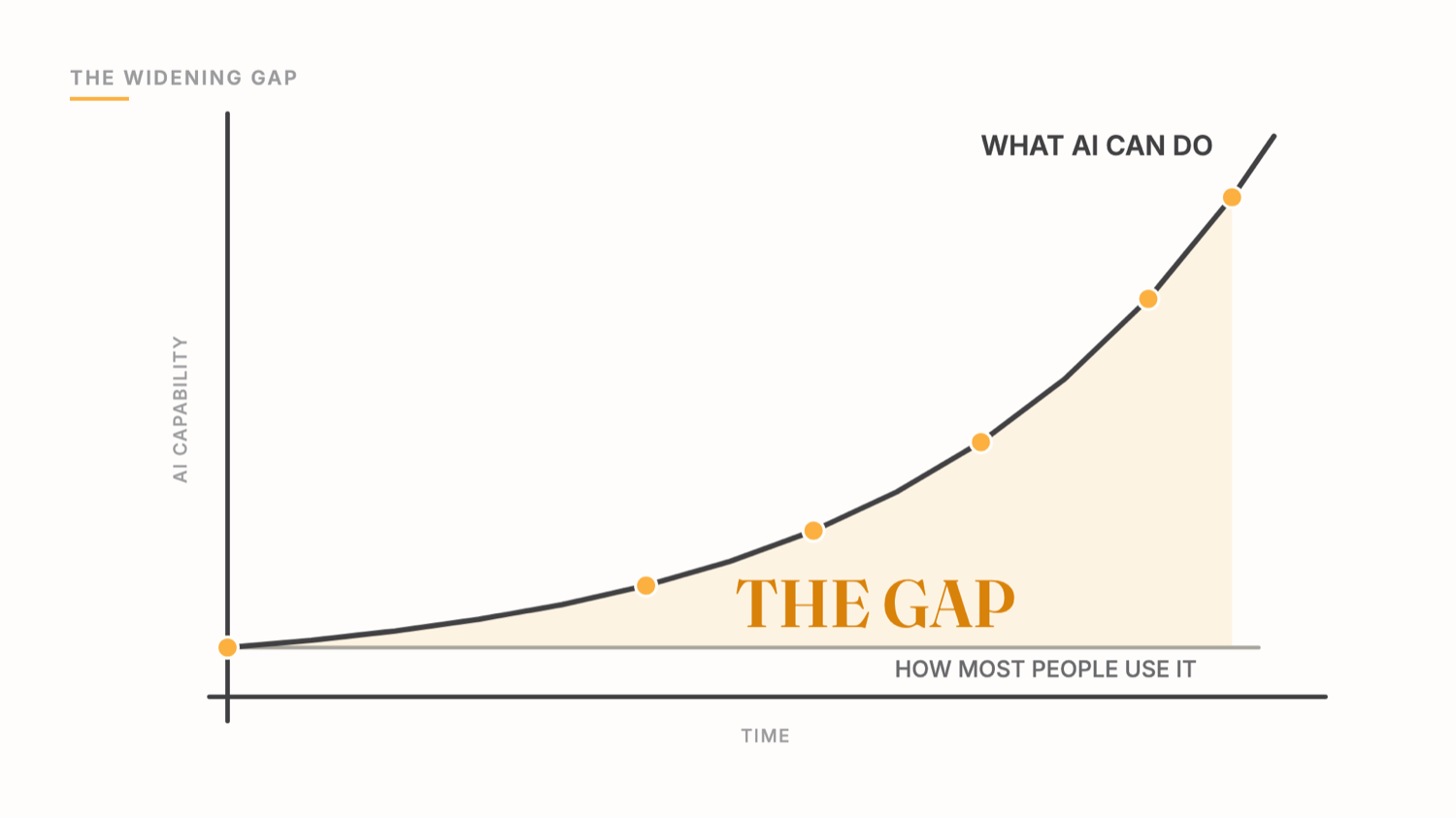
There is a widening gap between what today's AI can do and how most people use it. This is the training that closes it: a three-part arc that takes a team from a chat window to a working AI agent, and from curious to genuinely productive.

Most professionals use the worst version of the wrong tool.
They open a free chatbot, type a few keywords, and decide AI is overhyped. Meanwhile the tools get more capable every week.
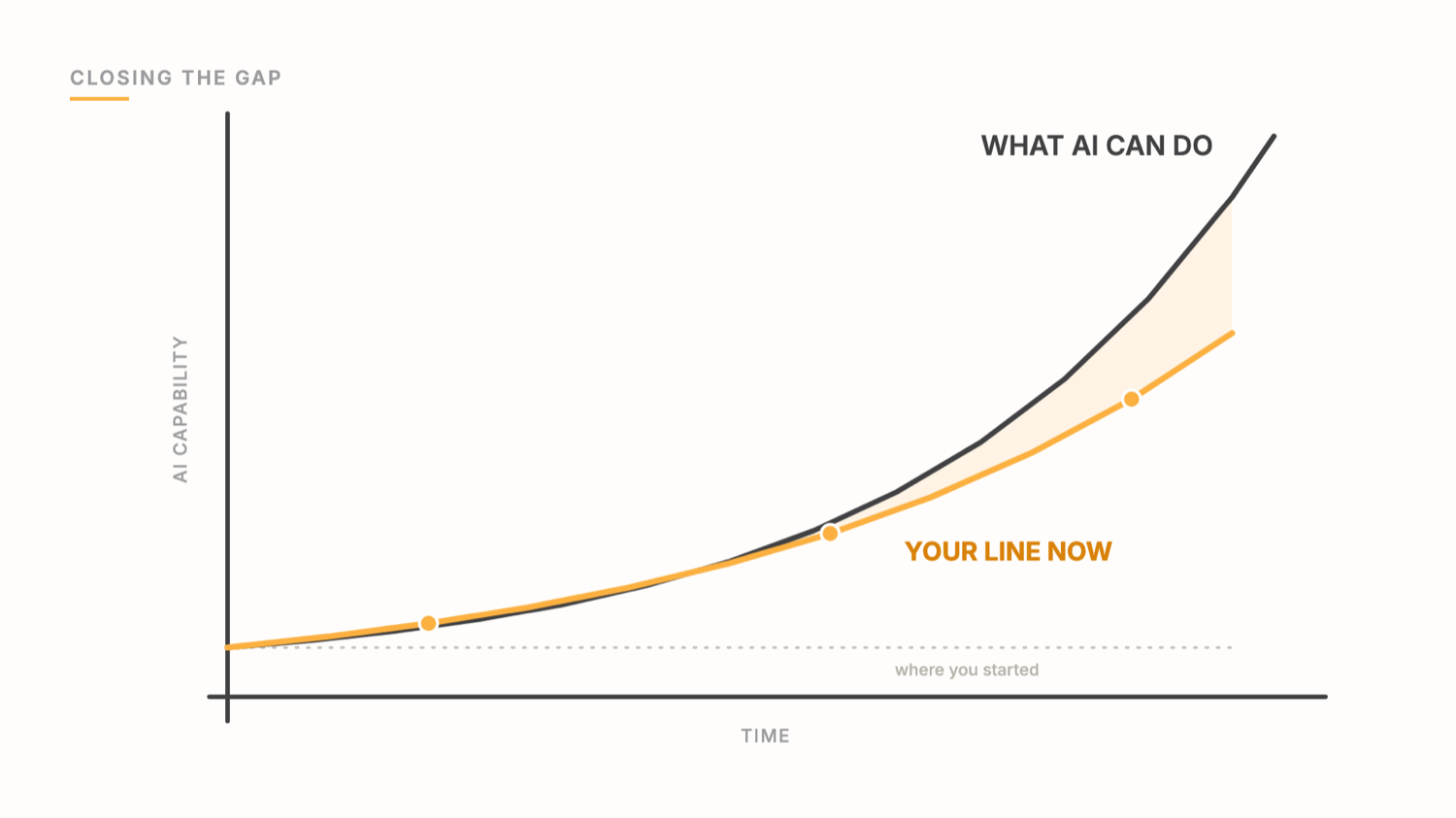
The gap is not a knowledge problem. It is a habits problem, and it compounds. A team that never moves past the search box quietly falls behind one that learned to brief, delegate, and dispatch. This training is built to move the line.
The core sequence
Chat. Delegate. Automate.
Three sessions, one arc. Each is a standalone hour that stands on its own, and together they carry a team from first login to real, supervised automation. This is the core intro-to-AI onboarding, the foundation the rest is built on.
How to Actually Use AI
“Most professionals use the worst version of the wrong tool.”
The landscape, from a chat window to a desktop agent, in plain language. Pick one good model and pay for it. Learn the eight-step climb from a search box to a real thinking partner, the guardrails that keep client work safe, and a 30-day plan to make daily use a habit.
Walk away with
Confident, everyday use of one good model, and a plan to make it stick.

Closing the Gap
“It is not a search box. It is a new hire.”
Stop typing keywords and start briefing the model like a sharp new colleague. Six moves that close the gap: give it the role and the real documents, push past the first draft, build reusable Projects, teach it who you are, and send it to do the research, then verify what matters.
Walk away with
A model that knows your world and produces real, usable work.

When the Model Leaves the Chat Window
“Chat is a thought in your head. Cowork is something you hand to someone else.”
The agentic leap. The model steps out of the chat box and starts doing the work on your computer: reading your files, drafting your email, building your reports. How to dispatch it with Cowork, when to reach for Code, and how to stay firmly in control while it works.
Walk away with
Real, multi-step jobs handed off, with supervision and safety built in.
The payoff
What your team keeps.
One tool, set up right
A single capable model chosen, paid for, and configured: memory on, profile set, guardrails understood.
A repeatable way to work
Briefing instead of prompting. Documents in, drafts refined, Projects built for the work that repeats.
Real work handed off
From a one-line question to a dispatched, multi-step job, and the judgment to know what to trust it with.
Something they keep
A one-page field card per session: the framework, the guardrails, and the exact next steps. Print it, pin it.
Why teams ask for me
Not only how to use it.
Most AI training stops at the tools. This doesn't. The AI conversation is usually framed as a technology debate. It is closer to an anthropology debate: what a human being is, and therefore what these tools are for. The people building the frontier models often answer that question very differently than the Church does, and that difference runs downstream into everything they make.
I work on this from three rooms at once: the pulpit, a PhD in AI ethics rooted in Christian ethics and public theology, and a company that ships AI products. So the practical craft in these sessions arrives with the framework underneath it, the theology of using these tools well, and the clash of worldviews your people are already feeling whether or not they have words for it yet. It is the throughline of my research and writing, from the organizing question In Whose Image? to the book behind it.
Every AI debate is really an argument about what a human being is.
Why this training is different
The tools serve the work.
Most AI training is either hype from someone selling a product, or fear from someone who has never used it. This is neither. It is taught by someone who builds these tools for a living and thinks carefully about the human questions underneath them: where the leverage helps, where it doesn't belong, and how to keep judgment in human hands.
Tools serve the work. They do not replace the one who owns it.
Every session ends where the technology stops and the person begins. Your team leaves with more leverage and a clearer sense of what to do with it, using the speed without outsourcing the judgment.
Bring it to your team
Book the training.
These three sessions are the core intro-to-AI onboarding, presented in person to your organization, or remotely for distributed teams, and tailored to your team's actual work. They are not the only talks I give. If you have a different audience or a deeper topic in mind, say so and we'll shape it together.
Your guide
Miles DeBenedictis
Miles is the founder of Nomion AI, a pastor, and a PhD student in AI ethics. He builds AI tools and trains teams to use them well, working at the seam between practical adoption and the human questions underneath it. He reads every email.